Your Blueprint for Meaningful Connection: The Engagement Tracker Log Book
In a world saturated with digital notifications and fleeting interactions, the true measure of progress often lies in the quality of our connections. For creators, entrepreneurs, educators, and community builders, understanding and nurturing these relationships is not just a soft skill—it’s a critical strategy. The Engagement Tracker Log Book KDP Interior provides a structured, tangible foundation for this essential work. It transforms vague intentions into actionable data, offering a clean, professional template designed to capture the nuances of how people connect with your work, your brand, or your community.
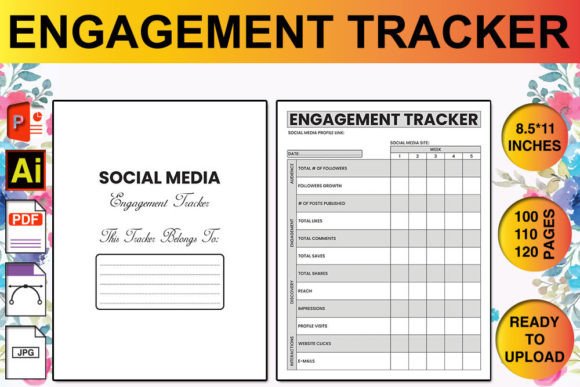
What makes this particular template immediately useful is its ready-to-publish design combined with its full creative sovereignty. You receive not just a print-ready PDF, but the complete PowerPoint, Illustrator, and InDesign source files. This means the Engagement Tracker Log Book is not a rigid product, but a starting point. With a trim size of 8.5" x 11" and options for 100, 110, or 120-page interiors, it’s built for practicality. The “no bleed” specification makes it straightforward for digital or physical use. The real value, however, lies in how you adapt its framework to your unique goals.
A Tool for Diverse Creative Professions
The core function of an engagement tracker is to log interactions, feedback, follow-ups, and outcomes. But its application is wildly different depending on who is holding the pen. A marketer might use it to meticulously record campaign responses, noting which messages resonated with which segments. An author or blogger could track reader comments, questions, and serial engagement to shape future content. An educator might adapt it to monitor student participation and identify moments where a learner truly connected with the material.
This flexibility is intentional. The provided source files (PPTX, AI, INDD) empower you to customize every element. Change the terminology from “Client Touchpoints” to “Audience Feedback” or “Community Notes.” Alter the column headers to track metrics that matter to you—be it sentiment, channel, conversion, or simply the depth of a conversation. This is not a generic log; it’s a canvas for your specific method of evaluation.
From Template to Tailored System
Consider the freelance designer using the tracker. They could modify the interior to not only log client communications but also to sketch quick ideas discussed during calls, creating a unified record of both dialogue and inspiration. A small business owner might use it to track customer engagement post-purchase, moving beyond simple sales data to understand loyalty and advocacy. The structure provides discipline, while your customization injects relevance.
Practical adaptation starts with a question: What does ‘engagement’ mean for my project? For some, it’s quantitative—numbers, dates, and rates. For others, it’s qualitative—themes, quotes, and evolving relationships. The Engagement Tracker Log Book KDP Interior supports both. You can add columns for numerical scoring or expand note sections for rich narrative detail. Using the Illustrator or InDesign files, you can even introduce icons, color-coding, or custom graphics that make the log intuitive for your personal workflow.
Building Consistency and Insight Over Time
The power of any log book is cumulative. A single page offers a snapshot; 100 pages compiled over a quarter reveal patterns, trends, and truths. This is where the tracker shifts from an administrative tool to a strategic asset. By consistently recording engagements, you build a proprietary dataset. You can identify which initiatives yield the deepest connections, which audiences are most vocal, and which approaches fall flat.
Keeping results clear and effective requires a minimal but consistent entry ritual. Design your customized version to make this easy. Perhaps you designate a weekly 15-minute review to transfer digital notes into the structured log. The physical or printable format, by design, encourages reflection that scrolling through a spreadsheet does not. For community managers, this could mean tracking member contributions not just by volume, but by the collaborative ideas they sparked, directly informing future community initiatives.
Creative Variations and Project Ideas
Beyond professional use, the template invites creative reinterpretation. A hobbyist leading a local club could use it to track event participation and ideas generated in meetings, transforming a casual group into a more organized, impactful one. A podcaster might create a version to log listener questions, guest insights, and episode feedback, creating a valuable content calendar from audience input.
One powerful approach is to segment the log by audience type or project phase. Using the multiple-page-count options, you could create distinct sections for different product launches, client cohorts, or course cohorts. The source files allow you to design divider pages or distinct thematic layouts for these segments. This turns the book into a multi-project companion, where each chapter tells the story of a different engagement journey.
Another idea is to integrate it with digital tools. The log can serve as the curated, summarized archive of insights pulled from various platforms. Notes from social media comments, email replies, and survey responses can be synthesized onto a single log page, providing a holistic view that scattered digital files cannot. The high-quality print-ready PDF ensures that if you prefer a physical master copy, it remains clean and professional.
Empowering Your Unique Process
The ultimate goal of this resource is to empower your process, not replace it. Whether you are a seasoned publisher on KDP looking for a niche interior product to offer, or a solo entrepreneur seeking to understand your client base more deeply, the control lies with you. The inclusion of PowerPoint, Illustrator, and InDesign files acknowledges that creativity exists in different ecosystems; you can work in the software you know best to mold the template to your vision.
This is a grounded tool for grounded creators. It avoids the hype of vague self-help journals by providing a specific framework for a specific task: tracking human connection in a meaningful way. Its utility grows not from complex features, but from your consistent application and intelligent customization. Start with the fundamental structure—date, contact, interaction notes, outcome—and then build upon it. Add a column for “next action.” Insert a field for “key takeaway.” Design a page that reflects not just what happened, but what it means for your next step.
By adapting the Engagement Tracker Log Book to your context, you create a living document that does more than record history. It informs strategy, fosters mindfulness about your audience, and turns everyday interactions into a map for growth. The provided files are your toolkit. The engaged connections you track are your compass. The result is a clearer path forward, built on the evidence of what truly resonates.