The Essential Guide to Tracing Alphabet Worksheets for Early Literacy Development
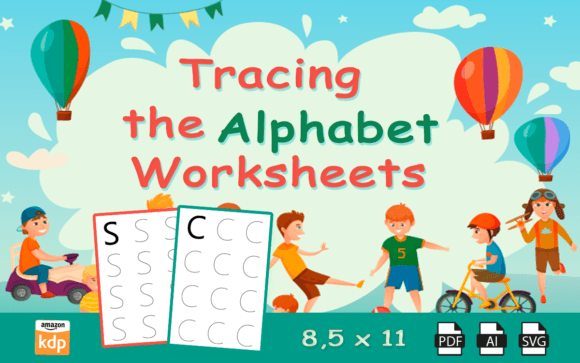
In the foundational journey of early childhood education, mastering the alphabet is the critical first step toward literacy. Among the most effective and time-honored tools for this mission are Tracing the Alphabet Worksheets. These structured exercises provide a hands-on, tactile approach to learning letter shapes, sounds, and formation, bridging the gap between recognition and writing. A dedicated set of 26 pages, with one letter per page, offers a complete and systematic pathway for preschoolers to build confidence and skill.
Understanding the Pedagogical Power of Letter Tracing
Tracing exercises are far more than simple drawing tasks. They engage multiple learning domains simultaneously. As a child guides a pencil along the contours of a letter, they are developing fine motor control, honing hand-eye coordination, and reinforcing visual memory. This multisensory experience—seeing the letter, hearing its name, and physically creating its form—anchors the symbol in the child’s mind. Worksheets designed for high-quality 8.5 x 11 inch paper provide ample, clear space for this practice, minimizing distraction and focusing effort.
Key Characteristics of Effective Alphabet Tracing Resources
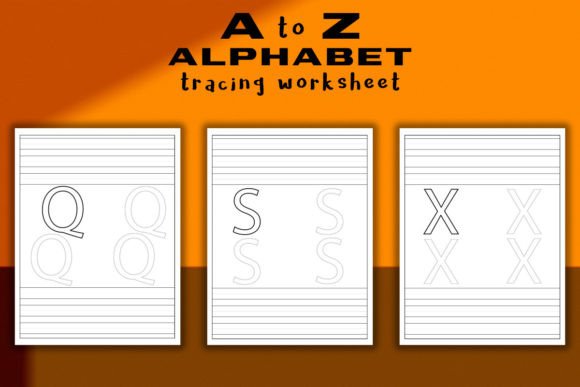
Not all worksheets are created equal. For optimal learning outcomes, certain characteristics are paramount. Each page should feature a single, large, clearly printed letter model, typically in both uppercase and lowercase formats. Dotted or dashed lines guide the child’s initial attempts, often progressing to solid lines for independent practice. High-resolution 300 DPI artwork ensures crisp, clean lines that are easy to follow. Furthermore, incorporating a relevant simple image or icon associated with the letter (like an apple for ‘A’) strengthens phonemic awareness—the connection between the letter and its sound.
Practical Advantages for Educators, Parents, and Creators
The utility of Tracing the Alphabet Worksheets extends across various user groups. For preschool teachers and homeschooling parents, a complete 26-page set represents a ready-to-use curriculum component. It provides structured, sequential activity that can be integrated into daily lessons without extensive preparation. For creators and publishers, such worksheets formatted for KDP (Kindle Direct Publishing) interiors, with no bleed and ready-to-upload AI, PDF, and SVG files, represent a viable and impactful product category. The demand for quality educational materials is perennial.
- Consistent Practice: Offers a reliable framework for daily alphabet work.
- Progress Tracking: A completed page per letter visually demonstrates a child’s journey.
- Resource Flexibility: Can be used in classrooms, at home, or in therapy settings.
- Commercial Potential: Well-designed worksheets meet a clear market need for foundational learning tools.
Real-World Application and Implementation
In a typical preschool setting, these worksheets are introduced gradually. A teacher might focus on a “letter of the week,” using the corresponding tracing page as a central activity. The child first traces, then attempts to write the letter independently, perhaps alongside coloring the associated image. The high-quality paper ensures that pencils glide smoothly and erasures don’t tear the page, making the experience positive and frustration-free. For creators, understanding this workflow is key to designing worksheets that are not just aesthetically pleasing but also pedagogically sound.
Design Considerations and Technical Specifications
Producing professional Tracing the Alphabet Worksheets requires attention to detail. The standard 8.5 x 11 inch (21.59 x 27.94 cm) size is ideal for young children’s desks and easy for parents to print. The “no bleed” specification is crucial for KDP print books, meaning all critical content stays within the safe margin area. Providing the resource as a single AI (Adobe Illustrator) file allows for future edits, while the PDF is the universal delivery format. Including 26 individual SVG files offers immense flexibility; each vector letter can be scaled infinitely without quality loss, used in digital apps, or for crafting custom projects.
This technical stack ensures the product is versatile: it can be printed as a physical workbook, sold as a digital download for home printing, or even serve as the asset base for more interactive digital learning applications. The 300 DPI requirement guarantees that printed versions are sharp and clear, a non-negotiable aspect for guiding tiny hands.
Beyond Tracing: Integrating Worksheets into Holistic Learning
While tracing is the core activity, excellent worksheets often incorporate extended learning opportunities. Space for the child to try writing the letter without guides, a section to draw something that starts with the letter, or a simple matching game enrich the page. This transforms a simple tracing exercise into a mini-lesson, covering recognition, writing, and application. For the educator, this means one resource can serve multiple objectives, maximizing instructional time and material value.
Trends and Evolution in Early Literacy Tools
The fundamental need for alphabet tracing remains constant, but the delivery and context evolve. There is a growing appreciation for worksheets that are part of a broader narrative or theme—perhaps tracing letters to help a fictional character solve a puzzle. Furthermore, the rise of digital printables has made resources like a 26-page PDF instantly accessible globally. However, the tactile, physical act of writing on paper is irreplaceable for motor skill development, underscoring the enduring relevance of printable, high-quality Tracing the Alphabet Worksheets.
Observations in educational research continue to validate the method. Children who engage in structured tracing activities often exhibit stronger letter formation habits and fewer reversals (like confusing ‘b’ and ‘d’) later on. The worksheet provides a controlled, error-correcting environment: the dotted line is the unambiguous correct path.
Final Considerations for Users and Developers
Whether you are a parent selecting resources, a teacher planning a curriculum, or a creator developing products, focus on quality and clarity. The worksheets should be visually uncluttered, instructions minimal (or pictographic for non-readers), and the letters presented in a child-friendly font. The sequence should follow a logical order, perhaps grouping letters with similar shapes or following the alphabet song. Remember, the goal is to build confidence. Each successfully traced letter is a small victory on the road to reading and writing.
In conclusion, Tracing the Alphabet Worksheets, especially a comprehensive 26-page set, are more than just pages; they are a scaffold for literacy. They translate the abstract symbols of our alphabet into concrete physical motions, building the neural and muscular foundations for all future writing. From the practicalities of KDP-ready design to the joyful moment a child recognizes their own ability to write an ‘M’, these resources remain an indispensable part of early learning landscapes.