The Essential Companion: Mastering Home Brewing Through a Purposeful Journal
Home brewing is more than a hobby; it is a craft of alchemy, patience, and continuous refinement. The transformation from humble grains and hops into a complex, satisfying beer is a journey of both science and art. While passion is the starter yeast, consistent record-keeping is the nutrient that allows expertise to flourish. For the dedicated homebrewer, a specialized tool—such as a home brewing journal—is not merely a notebook but the central repository of their brewing evolution.
The Anatomy of a Brewer's Log
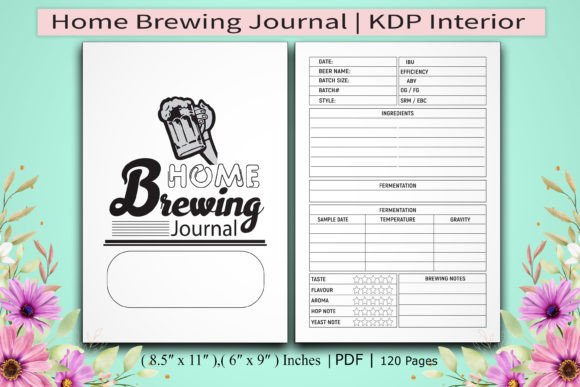
At its core, a home brewing journal is a structured framework designed to capture every critical variable of the brewing process. It moves beyond random scribbles on a notepad to provide a coherent, repeatable format for data entry. This typically begins with a recipe formulation section, where ingredients, quantities, and calculated metrics like original gravity and target bitterness are recorded. The heart of the log, however, is the brew day chronology.
Every stage, from milling and mashing to boiling, chilling, and pitching yeast, should be documented with timestamps, temperatures, volumes, and observations. Notes on yeast behavior, fermentation temperature fluctuations, and sampling impressions during conditioning are equally vital. This meticulous tracking creates a complete narrative of each batch, turning subjective experience into objective data.
Technical Development and Recipe Evolution
A static recipe is a snapshot; a brewing journal charts its motion. The primary power of this tool lies in enabling technical development. By comparing logs across batches, a brewer can isolate the effects of specific changes. Did increasing the mash temperature by two degrees produce a fuller body? Did a different dry-hop timing amplify the aroma? Without precise records, these questions are answered by guesswork.
Recipe iteration becomes a systematic experiment. Each entry serves as a control for the next. A journal allows you to annotate a base recipe with variations, creating a branching tree of your brewing explorations. This methodical approach accelerates learning, transforming intuitive tweaks into proven techniques. It is the difference between making occasional good beer and reliably crafting excellent beer that matches your intent.
Beyond the Brew: The Practical Advantages of a Dedicated Log
Utilizing a purpose-built home brewing log book offers tangible benefits that streamline the craft and enhance results. Organization is the first and most obvious advantage. Having all information in one dedicated place eliminates the frustration of searching through disparate notes, saved paper scraps, or forgotten digital files. This consolidation saves time and reduces errors on busy brew days.
Another significant benefit is quality control and consistency. When a particular batch turns out exceptionally well, the journal provides the exact blueprint to replicate it. Conversely, if a batch encounters an issue—such as off-flavors or stalled fermentation—the detailed log offers forensic clues to diagnose the problem. This turns setbacks into valuable learning moments rather than mysteries.
For those who share the craft, a well-maintained journal becomes a powerful communication tool. Sharing recipes and process notes with fellow homebrewers is far more effective with clear, comprehensive records. It fosters a community of knowledge exchange based on evidence, not just anecdote.
Considerations for Selection and Use
Choosing or creating a home brewing journal requires attention to layout and content. The structure should align with your brewing style. Some brewers may prioritize extensive sensory evaluation sections with grids for aroma, flavor, mouthfeel, and appearance scores. Others might need more space for equipment profiles and water chemistry calculations.
The physical or digital format is a personal decision. A printed log book, like those designed for KDP interiors, offers tactile simplicity and reliability at the brew bench. High-quality, print-ready PDFs with proper bleed ensure a professional, durable product. Standard sizes like 8.5" x 11" or 6" x 9" balance portability and writing space. The key is that the journal must be inviting and efficient to use during the actual process; if it's cumbersome, it will be neglected.
Commitment to use is the final consideration. The journal's value compounds with each entry. Making it a non-negotiable part of your brewing ritual, as essential as your sanitizer, ensures its data grows into your most valuable brewing asset.
Applications Across the Brewing Spectrum
The utility of a brewing journal extends across the diverse community of beer creators. For the novice, it serves as an educational scaffold. Following a recipe from a book is one thing; recording your execution of it teaches the why behind the steps. New brewers can track their initial successes and mistakes, building confidence and foundational knowledge more rapidly.
For the advanced hobbyist pushing into complex styles, sour beer production, or all-grain experimentation, the journal becomes a research notebook. Long-term projects like barrel aging or iterative souring blends demand historical data over months or years. Only a dedicated log can maintain that continuity.
Even for professional microbrewers or educators, the principles embodied in a home brewing journal are directly relevant. Scaling up a pilot batch from a homebrew system to a commercial one relies entirely on having accurate small-scale data. Educators in brewing courses can use the journal format as a teaching tool to instill disciplined methodology in students.
Observations from seasoned brewers often highlight that the most common regret is not starting rigorous documentation earlier. The beers you brew become memories; the journal you keep becomes your lasting and transferable wisdom.
Integrating the Journal into Your Brewing Workflow
To be effective, the journal must be integrated seamlessly into the brewing workflow. Preparation starts before brew day: filling in the recipe section, calculating targets, and noting any special instructions. During the brew, keep the log open alongside your equipment. Record data as steps are completed, not at the end of the day when details fade.
Develop shorthand for common entries to keep it quick. Use the fermentation section to schedule your future check-ins. After packaging, dedicate time to a final tasting note and overall assessment. This closing entry completes the cycle and provides the definitive evaluation for future reference.
The ultimate goal is a feedback loop where planning, recording, analyzing, and planning again becomes instinctual. Your journal evolves from a passive record to an active guide, informing your decisions for the next batch even before you measure your first grain.
The Tangible Outcome: From Data to Mastery
Over time, a filled home brewing journal transforms into something greater than a collection of pages. It becomes a personalized textbook of your craft. You can trace your progression from extract kits to decoction mashes, from fear of contamination to mastered yeast management. Patterns emerge that you could not perceive in single batches.
This accumulated knowledge fosters creativity. With a solid database of your past work, recipe design becomes less risky and more innovative. You can confidently hybridize elements from two successful past beers to create something novel. Your journal, in essence, codifies your unique brewing voice.
In a craft where variables are countless and outcomes are profoundly sensory, the home brewing journal is the anchor of objectivity. It tempers excitement with evidence and transforms curiosity into capability. Whether you are documenting a classic ale or a technical development experiment, each entry is a step toward mastery. The tool, much like a reliable fermenter or a precise thermometer, is foundational. It ensures that your effort, your ingredients, and your passion yield not just beer, but understanding, consistency, and the deep satisfaction of controlled creation.