The Teacher Journal Daily Reflection KDP: A Structured Tool for Educator Growth
In the demanding world of education, systematic reflection is not merely a best practice; it’s a cornerstone of professional development and well-being. The Teacher Journal Daily Reflection KDP is a pre-designed interior template specifically formatted for Amazon’s Kindle Direct Publishing platform. It represents a practical, off-the-shelf solution for educators, authors, or entrepreneurs looking to publish a structured daily journal for the teaching community. Unlike a generic notebook, this product is engineered with a clear purpose: to provide a consistent framework for daily professional reflection, packaged in a ready-to-upload format for self-publishing.
Core Purpose and Design Characteristics
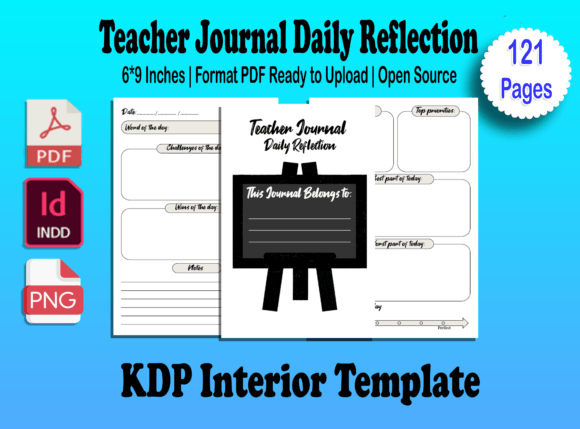
The primary intent of the Teacher Journal Daily Reflection KDP is to serve as a physical or printable tool that guides educators through a daily habit of focused reflection. The design is built around a 6" x 9" inch, 121-page non-bleed specification, a popular and practical size for journals. The absence of bleed simplifies the KDP upload process for publishers, ensuring the interior file aligns seamlessly with KDP’s trim requirements. This attention to technical specification is a significant strength; it removes a common hurdle for creators who may not have graphic design expertise.
The product includes high-quality print-ready PDF files, along with source files in Adobe InDesign and PNG formats. The inclusion of the InDesign source file is particularly valuable. It transforms the product from a static template into an open-source asset for customization. A publisher can modify layouts, fonts, color schemes, or prompts to better target a specific niche within education, such as early childhood educators or university lecturers. This flexibility elevates its utility from a single-use product to a foundational design system.
Evaluating Practical Value and Usability
From a usability standpoint, the Teacher Journal Daily Reflection KDP interior is reported as "100 tested on KDP." This claim suggests the files have been validated against KDP’s upload and preview systems, reducing the risk of technical rejection or formatting errors post-purchase. For a publisher, this reliability is crucial. Time spent troubleshooting margin errors or pixelated images can be a significant drain, and a pre-tested file offers a more predictable path to publication.
The journal’s structure presumably includes consistent daily entry pages with designated sections for reflection. A well-designed version would prompt the user to record not just events, but also emotional responses, pedagogical successes, challenges, and ideas for improvement. This structured approach contrasts with free-form journaling, which can become unfocused. For a busy teacher, a guided framework can make the habit more sustainable and analytically useful. The long-term value lies in the accumulation of this data, allowing for periodic review to identify patterns in teaching practice, student engagement, or personal stressors.
Strengths in Presentation and Consistency
The professional quality of the provided PDF indicates a focus on clean typography, balanced margins, and logical page sequencing. A polished interior presentation directly impacts the perceived value of the final printed book. An educator purchasing the journal is more likely to engage with a tool that feels thoughtfully designed and professional. Consistency across every page—the same header layout, prompt positioning, and space allocation—also fosters a ritualistic aspect to the reflection process, which can enhance habit formation.
The effectiveness of such a journal, of course, ultimately depends on the user’s commitment. However, the tool itself removes the barrier of creating the structure from scratch. For the publisher, the effectiveness is in the speed to market. With a fully formatted interior, the project shifts focus to cover design, marketing, and pricing, rather than page-by-page layout construction.
Who Benefits Most from This KDP Interior?
The primary beneficiary is the self-publisher targeting the educator market. This includes entrepreneurial teachers, educational coaches, or content creators specializing in professional resources. They gain a ready-made, customizable product that can be branded and sold under their own imprint. Secondly, the end-user—the practicing teacher—benefits from a physically or digitally available tool designed explicitly for their professional context.
The situations where this product fits best are clear. A teacher experiencing burnout or seeking a methodical approach to improving their instructional skills might use the journal for daily decompression and analysis. A school administrator might purchase bulk copies for a staff development initiative. A freelance educational writer might use the InDesign file to quickly create a series of themed journals for different subjects or grade levels. Its utility spans creation, distribution, and application.
Professional Observations and Realistic Application
In real-world application, a daily reflection journal based on the Teacher Journal Daily Reflection KDP template must compete with digital apps and simple notepads. Its advantage is tangibility and specialization. The physical act of writing can be more reflective than typing a quick note into an app. The teaching-specific prompts can direct thoughts toward professional growth rather than general diary entries. A practical recommendation for publishers using this interior would be to consider pairing it with supplementary material, perhaps a short guide on effective reflection techniques, to increase the overall value of the published book.
A potential limitation lies in its static nature as a starting point. While customizable, the base design might not suit every teaching philosophy or cultural context. The publisher must assess whether the default prompts and layout resonate with their target audience or require modification. Another consideration is market saturation. The education journal niche on Amazon is populated with many options, so differentiation through cover design, title, and marketing copy becomes essential even with a high-quality interior.
Assessing Fit for Your Goals and Workflow
If you are a publisher, your decision hinges on your design resources and timeline. If you lack InDesign skills and seek a "ready-to-upload" solution, the PDF file alone offers a quick launch pad. If you have design capability and wish to build a unique brand, the InDesign source files provide that crucial flexibility. For the end-user teacher, the fit depends on your preference for structured guidance versus free-form writing, and your commitment to a daily paper-based habit.
The Teacher Journal Daily Reflection KDP product, as described, appears to be a technically robust and thoughtfully conceived template. It addresses a genuine need in the educator community while providing a pragmatic asset for self-publishers. Its value is not in exaggerated claims of transformation, but in its concrete specifications: tested files, open-source customization, and a format dedicated to fostering a disciplined professional practice. For those aligned with its purpose, it represents a solid foundation for both publishing a product and engaging in a meaningful reflective routine.