The Pharmacology Planner Template: A Strategic Foundation for Medication Management and Patient Care
In the dynamic and detail-intensive world of healthcare, effective organization isn't just a convenience; it's a critical component of patient safety and professional efficacy. For pharmacists, nurses, healthcare students, and practitioners managing complex medication regimens, a systematic approach is paramount. The Pharmacology Planner Template is not merely a set of blank pages. It is a purpose-built, minimalist framework designed to structure critical pharmacological information, track administration schedules, monitor patient responses, and consolidate learning. Its strategic utility lies in transforming chaotic, high-stakes data into a clear, actionable, and reliable system.
Beyond Simple Note-Taking: A Tool for Operational Precision
Unlike generic notebooks, the Pharmacology Planner Template is conceived with the specific workflows of medication management in mind. Its value extends far beyond jotting down notes. It serves as a centralized command center for tasks that require unwavering accuracy. This can encompass tracking a patient's full medication profile—including names, dosages, frequencies, routes of administration, and prescribed durations. It provides a dedicated space to log vital signs, side effects, and lab values relevant to drug therapy, enabling a holistic view of treatment efficacy and safety. For students, it becomes an indispensable study companion, allowing for the organized compilation of drug classes, mechanisms of action, key indications, and contraindications in a format tailored for review and mastery.
Intentional Design for Practical Application
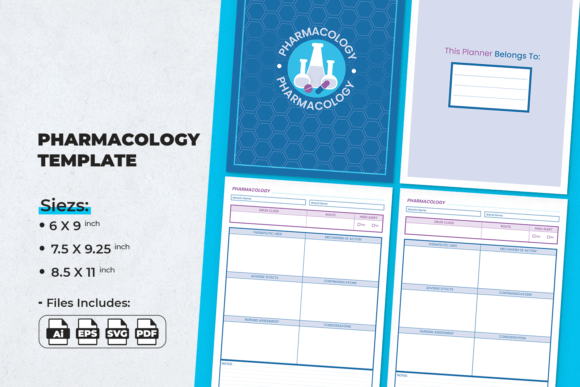
The template’s minimalist and functional layout is a deliberate strategic choice. It eliminates visual clutter, directing focus solely to the essential data fields. This clarity reduces cognitive load during high-pressure situations, where a missed detail can have significant consequences. The inclusion of multiple standardized sizing options—including the popular 8.5" x 11", 7.5" x 9.25", and 6" x 9"—means it can be seamlessly integrated into various professional environments. Whether placed in a clinic binder, a student backpack, or a home healthcare kit, the template adapts.
Features like high-quality 300 DPI print-ready PDFs with bleed and safe margins for hole punching ensure the physical product is as robust as its conceptual design. This attention to production detail means the planner is ready for professional printing via platforms like Amazon KDP or for endless reliable reproduction on a home printer, making it scalable for educational institutions, small practices, or individual use.
Strategic Use Cases: From Education to Clinical Practice
The Pharmacology Planner Template’s application is versatile, scaling from individual learning to team-based patient care.
- Pharmacology Education & Exam Preparation: Students can systematically catalog drug information by module or class, creating a personalized, searchable textbook that reinforces active learning and aids in long-term retention, directly contributing to academic success.
- Clinical Rotation & Internship Logs: Tracking hands-on experiences, specific medications administered, observed patient outcomes, and questions for supervisors turns a rotation into a structured learning journey, enhancing professional development.
- Patient Medication Profiling & Monitoring: In settings like home health care or outpatient management, a dedicated planner for a single patient aggregates all pharmacotherapy data. This supports continuity of care, helps identify potential interactions, and provides a clear record for communication with physicians.
- Research & Protocol Development: For those involved in pharmaceutical research or developing clinical protocols, the template offers a clean format to document drug trial observations, side effect incidence, and dosage adjustments.
Approaching the Template with Clear Goals
The greatest risk in using any specialized tool is applying it without clear objectives. Randomly filling pages of the Pharmacology Planner Template will yield limited benefit. The strategic approach begins with defining its primary role. Is it for mastering a semester’s curriculum? Is it for managing five specific long-term patients? Is it for preparing for a board certification exam?
Once the goal is set, customize the template’s use accordingly. Dedicate sections logically. For a patient profile, the first page might be a static list of all current medications with prescribing details. Subsequent pages could be daily or weekly logs for administration times, vitals, and noted effects. For study, organize by therapeutic area—antihypertensives, antibiotics, psychotropics—and leave space for adding clinical pearls encountered later.
Planning for Long-Term Value and Operational Integration
The template’s editable source files (such as AI Illustrator, EPS, or SVG) represent a significant strategic advantage. This isn't a static, one-size-fits-all product. Institutions or advanced practitioners can modify layouts to match specific institutional protocols, add branded elements, or create custom fields for unique research projects. This adaptability ensures the tool can evolve alongside professional needs, providing long-term value.
Integration into daily operations requires a habit-forming approach. Consistently carrying the planner and making entries part of a routine—after each study session, at the end of each patient visit, during every shift debrief—solidifies its role. The physical act of writing in a structured format also enhances memory and accountability, benefits that digital note-taking often dilutes.
Considerations Before Implementation
Before relying on the Pharmacology Planner Template as a primary system, consider the context. In fast-paced hospital settings where digital EHRs are mandatory, the planner may serve best as a personal shadow system for learning and quick-reference, not as the official record. It is a complementary tool that enhances personal organization and understanding, operating within the bounds of institutional regulations and data privacy laws.
Assess the volume of information. A single 6" x 9" planner might suffice for a focused exam study guide, while managing multiple complex patients may require the larger 8.5" x 11" format or multiple volumes. The decision is a practical one, impacting portability and completeness.
From Data Points to Coherent Understanding
The ultimate strategic outcome of using the Pharmacology Planner Template is the transformation of isolated data points into coherent understanding and improved action. A student moves from memorizing random drug facts to visualizing the interconnected landscape of pharmacotherapy. A nurse transitions from a task list of "give these pills" to a holistic narrative of how each medication influences a patient's day-to-day status. This deeper synthesis fosters better clinical decision-making, more confident communication with colleagues and patients, and ultimately, a higher standard of care.
By providing a structured canvas, the Pharmacology Planner Template encourages not just recording, but reflection and analysis. The blank spaces prompt questions: Why is this dose being adjusted? What is the correlation between this lab value and the drug started last week? This active engagement is the cornerstone of professional growth and expertise.
A Tool for Empowerment, Not Replacement
It is vital to frame this template correctly. It empowers the user by providing order and clarity, but it does not replace clinical judgment, official protocols, or verified reference materials. It is a strategic companion that reduces the friction of organization, allowing the practitioner's knowledge and expertise to focus on what matters most: the patient and the science. Used intentionally, with defined goals and a commitment to consistency, the Pharmacology Planner Template becomes more than a product—it becomes a foundational practice for anyone dedicated to the precise and thoughtful world of pharmacology.