A Guide to Tumbler Order Form KDP Interior: Evaluating its Role in Your Publishing Business
In the world of Amazon KDP Low and No Content publishing, efficiency and professional presentation are crucial for scaling a business. One resource that often comes under consideration is the Tumbler Order Form KDP Interior. This product is marketed as a tested, editable template designed specifically for creating order form books. Understanding what this interior offers, how it compares to general alternatives, and where its practical value lies is essential for publishers looking to optimize their workflow.
What Is the Tumbler Order Form KDP Interior?
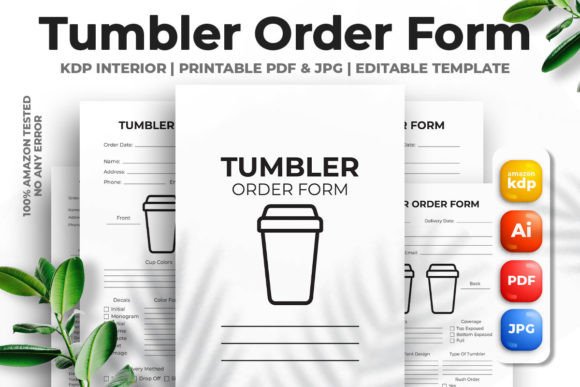
At its core, the Tumbler Order Form KDP Interior is a pre-designed book interior template. It is formatted for a 6x9 inch book size and consists of 120 pages of structured order forms. Its defining characteristic is its claim to being a fully vector editable PDF, which means the file can be opened and modified in software like Adobe Illustrator, allowing for resizing and customization without loss of quality. The package typically includes high-resolution JPG files and a print-ready PDF, all tested for Amazon KDP’s upload requirements. This positions it not as a generic notebook, but as a specialized tool aimed at the niche of tumbler (or similar custom product) order tracking.
Key Features and Their Practical Implications
Evaluating the features listed for the Tumbler Order Form KDP Interior reveals both its potential strengths and the considerations one must weigh.
- Vector Editable PDF: This is a significant feature for those with access to and skill in using vector graphic software. It offers true flexibility in altering layouts, colors, and sizes, a level of control not typically available with standard PDF or Word document templates. However, for publishers who only use simpler tools, this feature may be less accessible.
- Amazon KDP Tested: The assurance of being “100 Tested on Amazon KDP with No Any Error” addresses a common pain point: technical rejection during upload. This can save considerable time and frustration, compared to using untested or self-made templates that might have margin or bleed issues.
- 120 Pages & No Bleed: The fixed page count provides a complete book length, suitable for a dedicated order log. The “No Bleed” specification confirms it’s designed for interiors only, which is correct for this type of functional book.
- High-Resolution Files: Including 300 DPI JPGs offers alternative use cases, such as using individual pages for other marketing materials, though the primary value remains in the complete book file.
Comparing Approaches to KDP Order Form Books
When considering how to produce an order form book for KDP, publishers generally have three broad paths: using a specialized template like this one, creating a custom design from scratch, or utilizing a more basic, multipurpose template.
The Custom Design Route
Designing an interior completely independently offers unlimited creative control. You can tailor every field, font, and layout to a specific client or product line. This approach, however, demands significant time, graphic design expertise, and requires you to navigate KDP’s technical specifications yourself. It’s a high-input option suitable for established brands with unique needs, but inefficient for publishers aiming for rapid, scalable production of low-content books.
Generic and Multipurpose Templates
The market is filled with generic logbook, journal, and notebook interiors. These can be adapted for order tracking by adding handwritten columns. They are often inexpensive or free. The tradeoff is a lack of specialization. The layout won’t be optimized for an order form’s typical data (customer name, design, payment status, etc.), potentially looking less professional. Furthermore, their testing for KDP compliance may be less guaranteed, and they rarely offer the deep, vector-level editing of a specialized product.
The Specialized Template: Tumbler Order Form KDP Interior
Here, the Tumbler Order Form KDP Interior finds its potential niche. It sits between the generic template and the full custom design. It provides a structure specifically purposed for order management, which adds perceived value for the end-customer buying the book. The tested reliability reduces operational risk. The vector editability, for those who can use it, allows for a degree of branding and adjustment without starting from zero. Its primary limitation is its specificity; it is designed for a certain use case. If a publisher wants to branch into different types of logbooks (like fitness or gardening journals), this template would not be directly applicable.
Decision Factors: When Is This Interior the Right Fit?
Choosing to utilize the Tumbler Order Form KDP Interior depends on several factors related to your business model, skills, and goals.
It may be a strong candidate if your publishing focus is on functional business or craft-related low-content books, particularly around custom products like tumblers, mugs, or apparel. The pre-structured form fields can accelerate your production cycle. If you prioritize reducing upload errors and technical reviews on KDP, the tested claim offers a tangible benefit. Furthermore, if you or your designer are comfortable with Adobe Illustrator, the vector PDF feature unlocks customization that can help differentiate your product in a crowded marketplace without extra design time.
Conversely, you might need another option if your scope is broader. Publishers creating a wide array of low-content themes (planners, diaries, habit trackers) would likely find a single-purpose interior too limiting. Also, if you lack vector software skills, the core editable feature becomes less valuable, and a simpler, cheaper PDF template might offer similar utility. Lastly, if your strategy involves extreme low-cost entry, investing in a specialized template might not align with initial financial constraints, though the time savings could offset the cost later.
Evaluating Quality and the “Professional Collective” Claim
The product description mentions origin from a “professional global creative collective with over 10 years of experience.” In the context of KDP templates, such claims point towards an expectation of refined design and technical accuracy. For a buyer, the evidence lies in the details of the files: the cleanliness of the vector paths, the appropriateness of the layout, and the absence of formatting errors. A well-designed specialized template should not only function but also exhibit a visual professionalism that surpasses a quickly assembled generic alternative. This can contribute to the perceived value of the final published book on Amazon.
Tradeoffs and Realistic Application
Adopting any pre-made template involves tradeoffs. The Tumbler Order Form KDP Interior offers efficiency and specialization but at the cost of flexibility for other book types. It provides technical confidence but requires an investment upfront. A realistic example: a publisher targeting the craft seller community could use this template to quickly launch a series of “Tumbler Design Order Log” books, customize the color scheme for different volumes using Illustrator, and upload them with minimal technical delay. This streamlined process allows for faster market testing and scaling. However, that same publisher would need to source a different template entirely to launch a “Client Meeting Planner” book, as the order form structure is not transferable.
Ultimately, the Tumbler Order Form KDP Interior is a tool designed for a specific segment of the KDP publishing ecosystem. Its value is not universal but situational. For publishers whose strategy aligns with its specialized function, and who can leverage its technical features, it represents a pragmatic resource that can reduce friction in the production process. For those with a divergent focus or different operational constraints, the broader market of templates and design approaches will offer more suitable paths. Making an informed decision involves honestly assessing where your business falls on that spectrum.